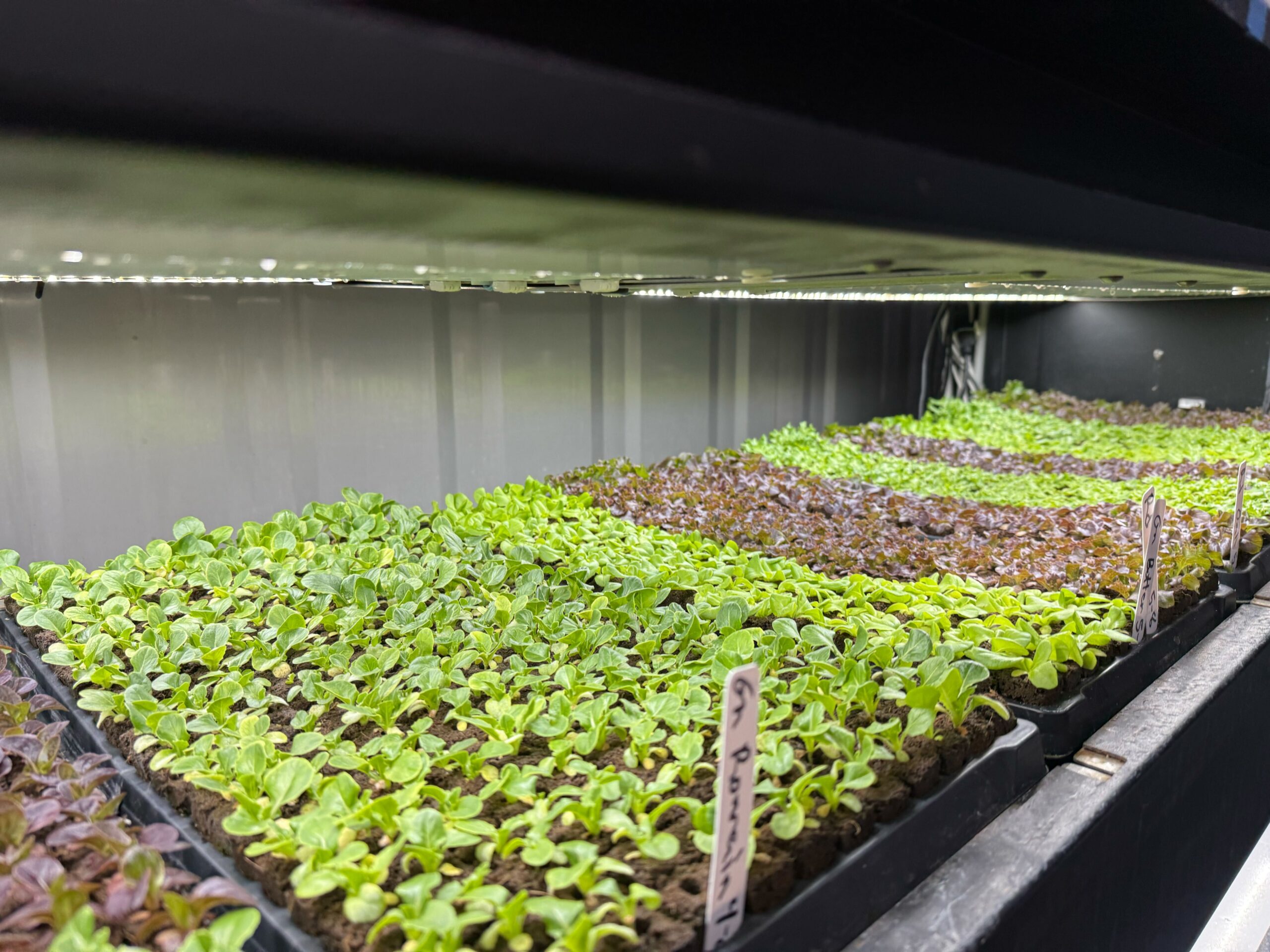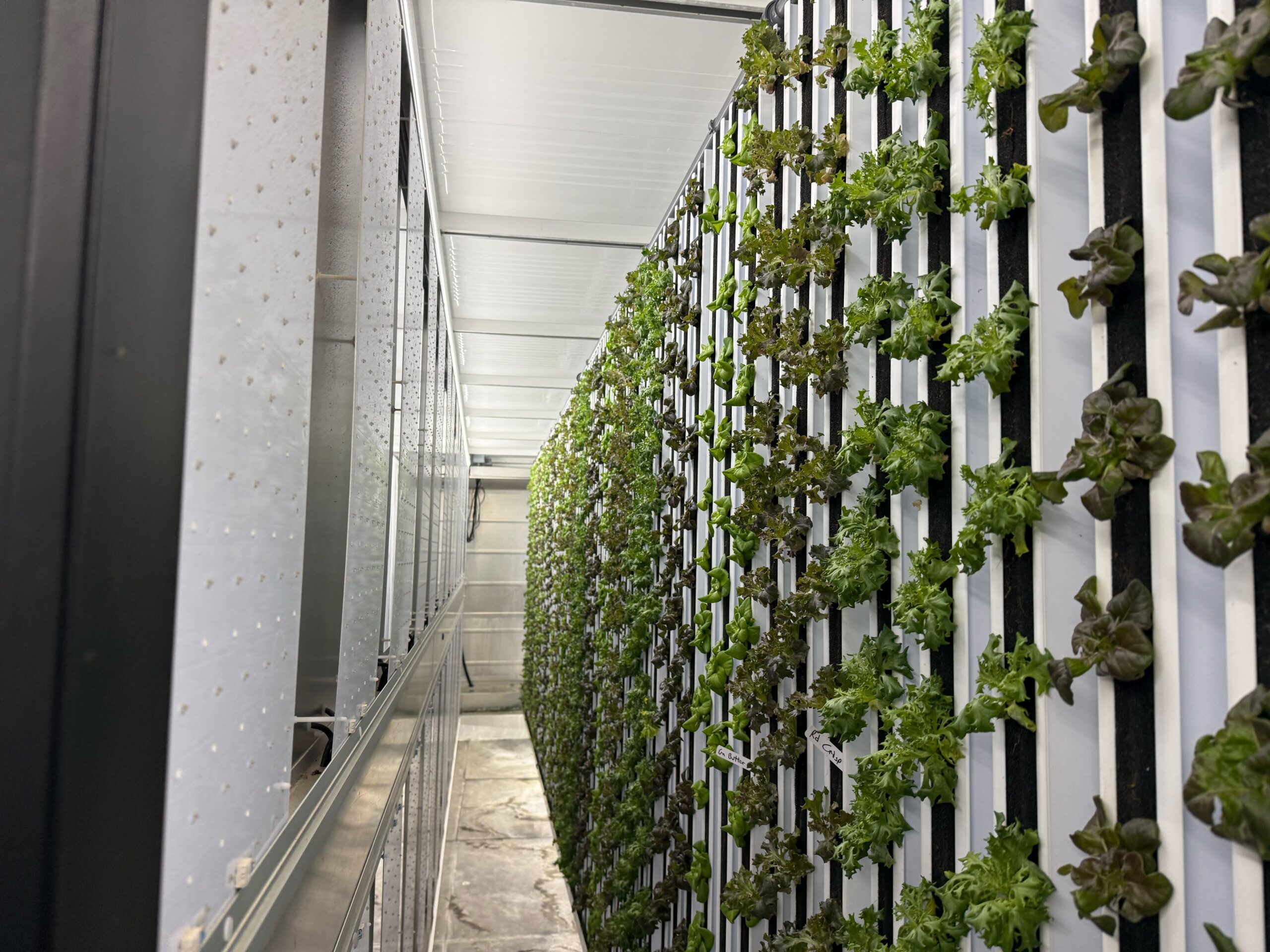
Indoor farming saves water, reduces crop exposure to pests and pathogens, and produces high yields in a small footprint. But indoor farms are energy-intensive, and HVAC systems are often the largest consumer of that energy due to high dehumidification loads produced by crop transpiration. A CalNEXT-funded project led by engineers from University of California (UC) Davis set out to evaluate a more efficient alternative to conventional HVAC approaches—with promising results.
Modern indoor farms typically use one of two approaches, and they both waste energy. The first involves placing portable dehumidifiers inside the grow space. While this removes moisture, it also adds heat to the farm—requiring the addition of an air conditioning system to remove the excess heat. This results in multiple refrigeration systems running simultaneously.
The second approach pairs an air conditioning system with a natural gas or electric resistance heater. The air conditioning unit’s cooling coil removes moisture from the air but overcools it in the process—requiring re-heat to return to normal temperatures. Gas or electric, energy is wasted in removing heat only to replace it afterward.
Both approaches are inefficient in their own way; they either require multiple refrigeration systems or remove heat just to add it back in after moisture removal.
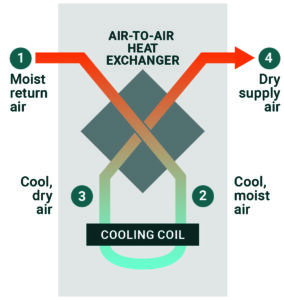 An alternative approach pairs a conventional air conditioning system with a plate air-to-air heat exchanger. In this system, air passes through one half of the heat exchanger, then through a cooling coil, and finally through the second half of the heat exchanger.
As the air passes through the first half, it transfers heat to the air moving through the second half, pre-cooling the air and bringing it to a temperature close to its dew point (the temperature at which moisture condenses out of the air). As a result, the cooling coil provides primarily latent cooling (moisture removal) rather than sensible cooling (temperature reduction). As the air exits the cooling coil, it passes through the second half of the heat exchanger, where it absorbs heat from the air passing through the first half. This warms the air and reduces or even eliminates the need for re-heat energy.
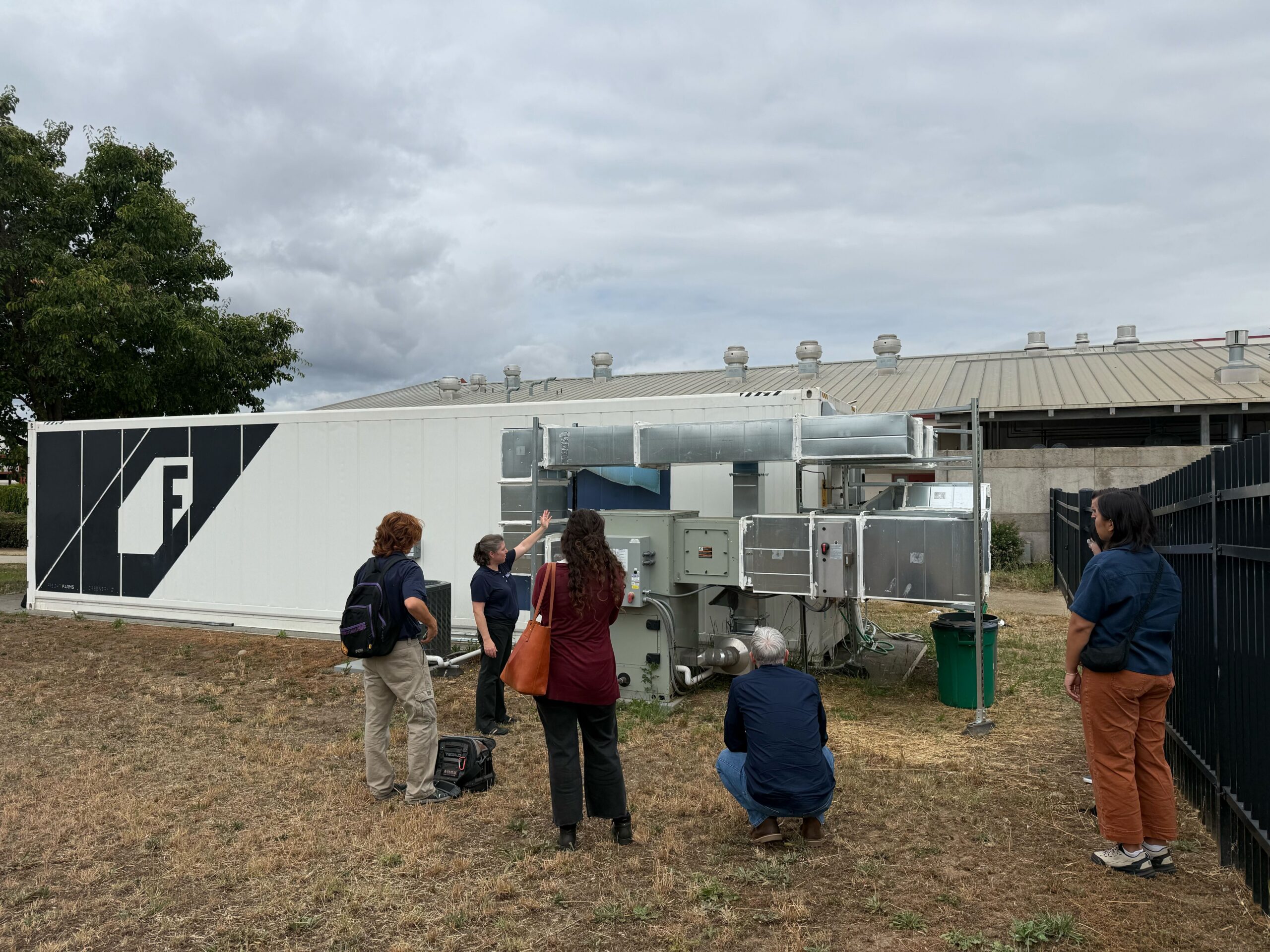
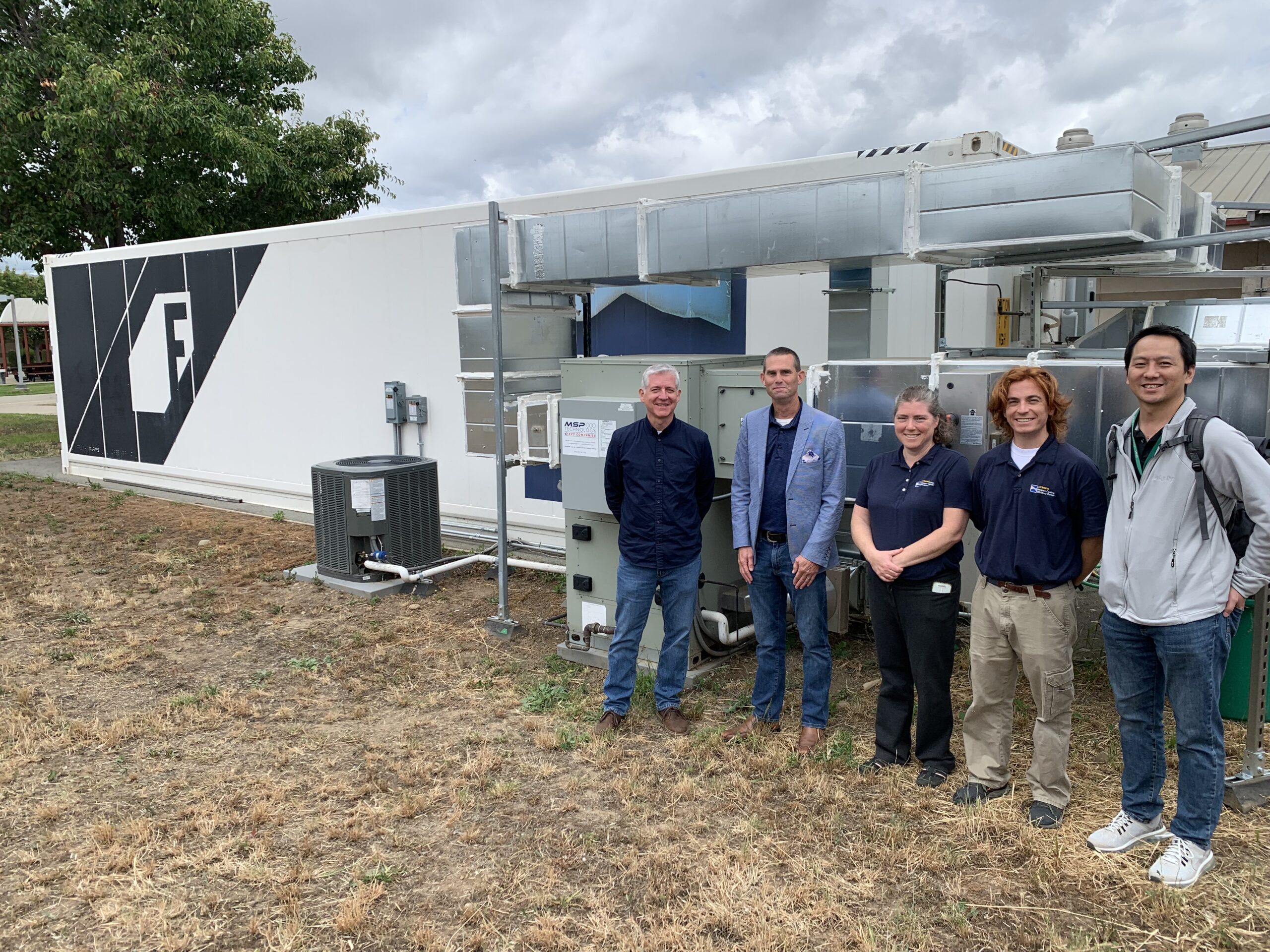
To evaluate this technology, the project conducted a field demonstration at two indoor container farms at Ann Sobrato High School in Morgan Hill, California. The side-by-side setup allowed researchers to compare the integrated heat exchanger air conditioning system directly against a packaged air conditioning system with electric resistance re-heat, with both systems operating under similar loads and weather conditions. The project evaluated energy use and savings, demand impacts, and the system’s ability to manage cooling and dehumidification loads. Michael Jochner, Director of Student Nutrition at Morgan Hill Unified School District and one of the project’s hosts, detailed his experience with the technology. “I got educated on how the heat exchange plate worked and how all the technology worked. It was really fascinating to me,” he explained. “When the numbers started coming back from UC Davis, even they were impressed with how well it worked.”
The results were clear: The integrated heat exchanger system demonstrated approximately 39 percent energy savings per day compared to the baseline system. The project also documented installation and operational considerations, providing field-validated data to inform future retrofit efforts.
Jochner went on to explain the positive effects on the students as well, describing “the added benefit of having this out of high school—we had students that were intrigued and wondering what was going on…that has always been important to me, to be able to show high school kids a pathway beyond high school. Being able to showcase these things in a K-12 setting is crucial, because that’s really where you start to spark the passion.”
Indoor farming is an emerging industry, and this type of HVAC technology is relatively new to California farms. The Morgan Hill project demonstrates the feasibility of the integrated heat exchanger approach in the state and provides the field-validated performance data needed to support broader adoption.
For farmers, the technology offers the potential for significant cost savings while supporting sustainable production and contributing to California’s decarbonization goals. CalNEXT funds this kind of research, evaluation, and field demonstration to move emerging energy efficiency technologies forward, helping good ideas become practical, proven solutions for California’s industries.
“Technology is useless unless it benefits humanity,” Jochner explained, reflecting on the outcome of the project. “And so, if a piece of technology could do something better, why not let the technology do that, and then let the traditional farmer grow what they grow best?”
Learn more about the energy savings from the final report, Humidity Control for Indoor Farms.